



Shopify for art, design and print as a brand
For illustrators, design studios and artists who sell their work across many products: prints, cards, textiles and objects, where the artwork is what the customer is really looking for.
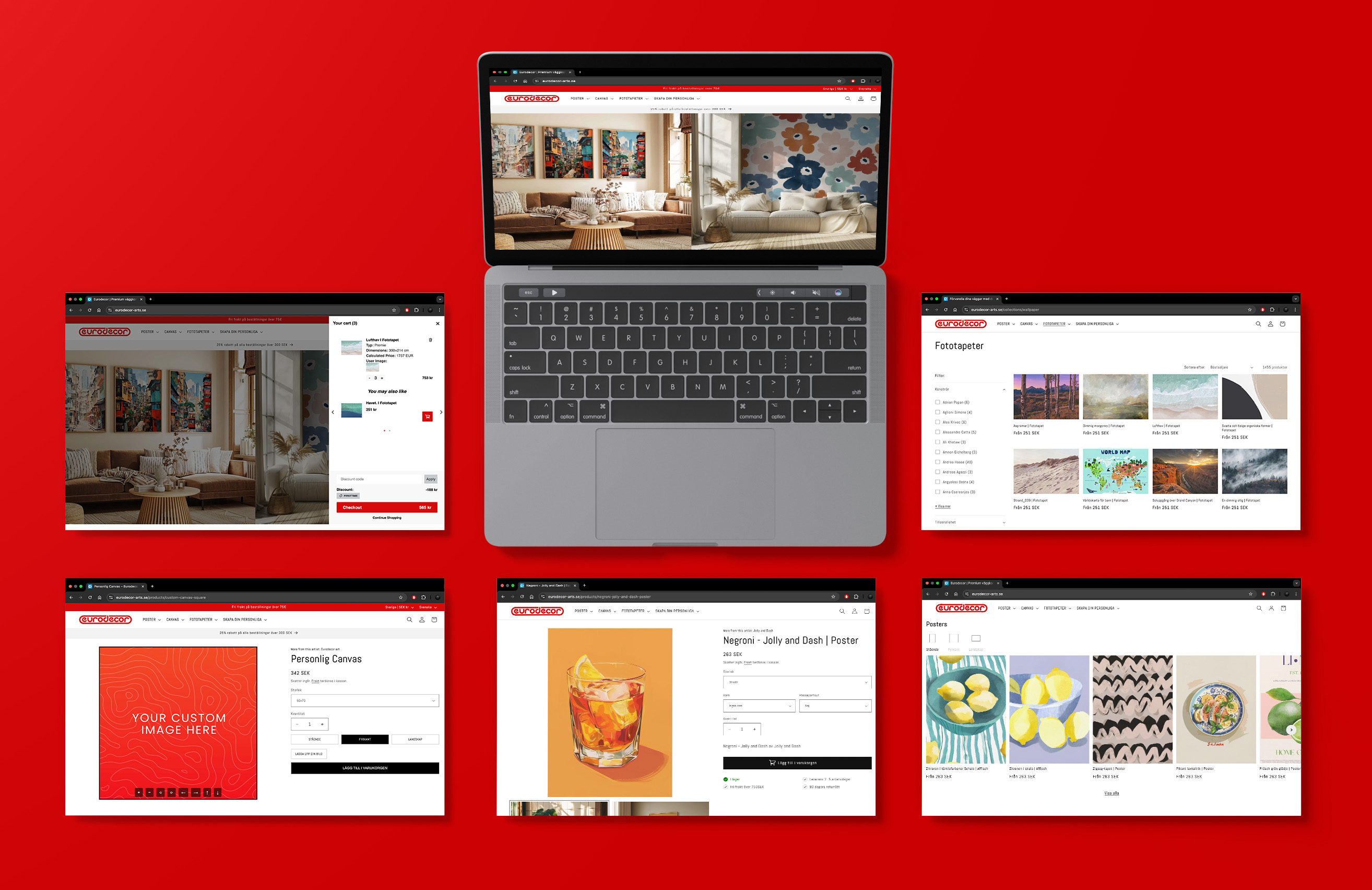
The customer buys the artwork, the product comes second
A design shop is rarely a catalogue of product types. The customer has seen an illustration on Instagram or at a retailer and wants to find that exact artwork, then choose whether it becomes a print, a postcard, a tea towel or a mug. So the shop has to be navigable along two axes at once: artwork and series one way, product type and format the other.
The brand carries the sales. The same line, colours and feel should come through from the home page to the order confirmation, and new collections are often released as small launches with a newsletter and social posts in advance. Signed and numbered editions sell on scarcity, while cards and posters sell on volume, and both need to fit in the same shop without one making the other look cheaper to the customer.
Many designers also sell to shops. Retailers want wholesale terms, a minimum order and their own login, and they should not see the consumer campaigns.
What is usually included
- Artwork navigation
- Collection launches
- Editions
- Retailers
- Brand design
What we build for art, design and print
We build the shop around the artworks and make product types a choice, so a new artwork can be released on five products without five separate listings.
- Artworks and series as metaobjects linked to every product with the same artwork
- Filters for product type, format, colour and series
- Numbered editions with a visible sold-out status
- Launch pages for new collections with a waiting list
- A wholesale area for shops that stock your products
- Custom theme sections for artist portraits and process images
Systems and apps that are often connected
We choose a proven app when it is enough and build a custom integration when it is not.
-
Klaviyo
Waiting lists and emails ahead of collection launches, segmented by which artworks and series the customer has bought before
-
B2B app or Shopify B2B
Price lists, minimum orders and a separate login for shops that sell your cards and prints
-
Print on demand partner
Prints artworks on textiles and objects you do not want to stock, with orders sent straight from Shopify
-
Fortnox (Swedish accounting software)
Sales from the web, retailers and markets collected in your accounts
-
Shopify POS
The same stock and customers when you sell at Christmas markets, design fairs or in your own studio
What is easy to miss
-
One artwork, twenty products
When every combination of artwork and product type is listed separately, the range becomes impossible to update and the customer cannot find all versions of the same image.
-
The edition sells out quietly
Numbered prints need stock per edition and a clear status, otherwise copies that do not exist get sold, or the page disappears and the links die.
-
Wholesale sees campaign prices
Without separate price lists, shops that stock your products see the same discounts as consumers, which leads to unnecessary conversations.
-
Images weigh down the page
High-resolution artwork images without the right image format make the mobile page slow, and mobile is where most people discover you.
The artwork as the core of the data model
Each artwork becomes a metaobject with a name, series, artist and story, and the products point to it. A page for an artwork can then show everything available with that image, and a new product type can be added to existing artworks without rewriting any copy. The same thinking applies whether the store has a hundred artworks or thousands: images, categories and data have to fit together.
A visual store we have built
Wallinspo sells wall art with room-setting images, category entry points by motif, material and style, and its own poster maker where the customer uploads a photo, adjusts the crop and sees the result with the chosen frame before buying. It shows how we think when the image is the product.
Cases like yours
All projectsCommon questions from designers and artists
Can the same artwork be sold on several product types without duplicate work?
Yes. The artwork is created once as a metaobject with image, name and text, and each product is linked to it. When you release the artwork on a new product type, the product page pulls the description and related products from there. The customer can go from a card to the same image as a print in one click.
How do we show numbered editions?
The edition gets its own stock level and a field for its size, for example the total number of copies, which is shown on the product page. When it sells out the page stays up as sold out with a link to similar artworks, so links from press and social media keep working.
Can shops order wholesale in the same Shopify?
Yes, with Shopify's built-in B2B or a B2B app, depending on your plan and needs. Retailers log in and see their prices, minimum order and payment terms, while consumers see the normal shop. Stock and product images are shared between both.
Do we need to hold stock of everything we sell?
No. Prints and cards that sell steadily suit your own stock, while textiles and objects with many sizes often work better with a print on demand partner. Both can live in the same shop, and the customer sees one delivery time per product.
Should the frame be a variant or a separate product?
It depends on how you produce. If you frame the prints yourself before shipping, the frame works as a variant with its own image for each combination. If you sell frames that also fit other prints, they can be separate products suggested on the poster page. Both can be built without an app.
What does Pictufy do in a Shopify shop?
Pictufy gives access to art prints that are produced and shipped to order. The artworks are added as products in Shopify, and orders go to print automatically. It suits you when you want a wide range without holding stock of every size.
Building for this industry?
Answer a few questions and see a preliminary price right away. We call you and finalise it together with you.
Rather talk directly? hej@wubs.se · 076-191 68 42